Uruguay
An official report projects that BRT on 18 de Julio will maintain a speed close to the current one
A Redes study released by the Ministry of Transport assessed the corridors in the metropolitan reform. On the stretch along 18 de Julio, the operating speed of the bi-articulated buses would be between 12 and 18 km/h.
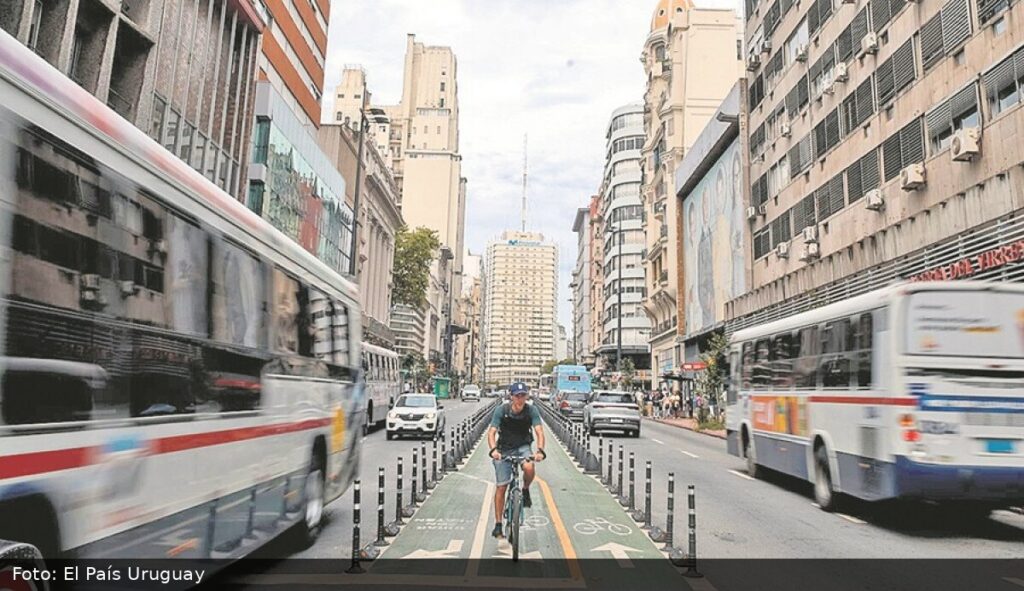
A report by the company Redes, published by the Ministry of Transport and Public Works of Uruguay and cited by El País, indicates that bus traffic on 18 de Julio would remain similar to the current situation under the metropolitan transport reform.
The document analyzes the BRT model chosen by the government over other alternatives, such as the tram and the metro, for the corridors already defined. Bi-articulated buses are expected to connect Zonamérica with Ciudad Vieja via Camino Maldonado, 8 de Octubre and 18 de Julio, and also El Pinar with Ciudad Vieja via Giannattasio, Avenida Italia and 18 de Julio.
According to the study, on 18 de Julio the estimated operating speed for the BRT would be between 12 and 18 km/h, a range it describes as “similar” to the current situation, now below 15 km/h. The report attributes that limitation to the high number of intersections. By contrast, for Camino Maldonado and 8 de Octubre it projects speeds of 18 to 20 km/h, and for Giannattasio and Avenida Italia, 18 to 25 km/h.
The study also warns that punctuality and service regularity on 18 de Julio would be low because of the frequency of crossings, the density of vehicles and people, as well as incidents and blockages. It also cites operational flexibility problems due to the high incidence of demonstrations and the system’s vulnerability to interference. Even so, the report considers that a tram would be even more rigid.
El País recalled that in March President Yamandú Orsi ruled out building a tunnel under 18 de Julio, an option that offered better travel times and speeds, but required a larger investment and a stronger urban impact in the short term. With underground construction, the BRT could reach between 25 and 32 km/h on that avenue.
According to information published by the ministry and reported by El País, the estimated initial investment for the BRT reform is US$ 575 million, compared with US$ 1,544 million if trams were chosen for the same routes. The annual operating and maintenance cost would also be lower in the bus system: US$ 43 million versus US$ 68 million.
The Uruguayan outlet added that, according to official documents, civil works would cost US$ 400 million, rolling stock US$ 95 million and equipment nearly US$ 80 million. Each bi-articulated bus would have a value close to US$ 950,000, in a planned fleet of 100 units.
The overall goal of the reform is to raise the average speed of metropolitan public transport from the current 16 km/h to around 25 km/h. According to the report from the Metropolitan Transport System Agency cited by El País, the lower cost of the BRT would make it possible in the future to expand the trunk network from 50 to 200 kilometers.
Sources
About this note. Written by El Notero with the assistance of artificial intelligence, based on what was published by the cited outlet. El Notero did not conduct its own reporting on this event.