Uruguay
Criticism of the Judiciary over dictatorship cases grows in the Uruguayan Parliament
Over the past year there were at least five events in the annex of the Legislative Palace with criticism of the Prosecutor’s Office and the Judiciary over crimes against humanity cases. Academics, the Prosecutor’s Office and human rights organizations warn about the effect of those remarks and signs of weakening of the specialized prosecutor’s office.
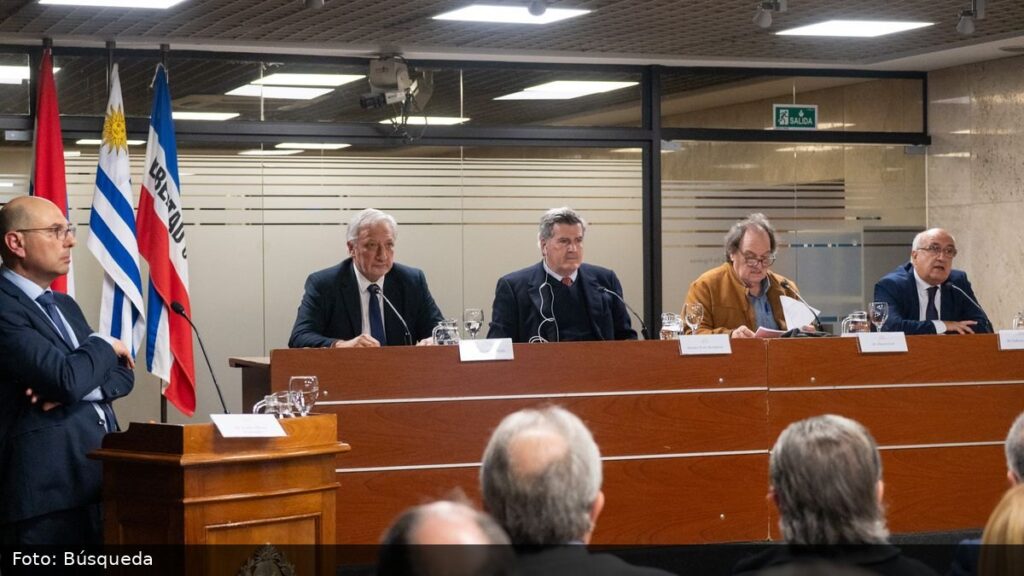
Over the past year, the annex of the Legislative Palace was the scene of at least five panel discussions in which the Judiciary’s handling of cases against retired military officers prosecuted or convicted for human rights violations during the dictatorship was questioned, according to Búsqueda.
Four of those events were part of the La Justicia en Debate series, promoted by Colorado Senator Gustavo Zubía. According to that outlet, political figures such as Sergio Botana, Graciela Bianchi, Pedro Bordaberry, former senator Guillermo Domenech, former deputy Eduardo Lust and former presidents Julio María Sanguinetti and Luis Alberto Lacalle Herrera took part. In those meetings, they spoke of an “ideologized” prosecutor’s office, argued that the proceedings do not offer sufficient guarantees to the accused, and said there are convictions without evidence, although without mentioning specific cases.
The events were introduced by the lawyer for the Centro Militar, Emilio Mikolic, defense counsel for defendants or accused persons in more than 80 cases linked to torture, unlawful deprivation of liberty, rape, enforced disappearances and homicides. According to Búsqueda, despite the criticism, judges, appeals courts and the Supreme Court of Justice have upheld the convictions. So far, more than 120 people have been tried for crimes committed during the dictatorship in Uruguay.
On August 21, another event was also held at the Legislative Palace, as part of the International Day of Remembrance and Tribute to the Victims of Terrorism, with the participation of Sanguinetti and Lacalle Herrera. There, the judicial performance in these cases was also criticized, the accounts of the dictatorship and the preceding years were questioned, and the need for a “necessary revisionism” was raised, Búsqueda reported.
At that event, organized by the so-called Centro de Estudios de Derechos Humanos del Uruguay, Lacalle Herrera said the country is going through a “great national fracture” and argued that there is decay in the exercise of law within the Judiciary. He also said that, in some cases, judicial action “looks more like revenge than justice,” according to the audio of the meeting reviewed by Búsqueda.
Historian Magdalena Broquetas, director of the Department of History of Uruguay at the Faculty of Humanities of the Universidad de la República, told Búsqueda that these speeches seek to delegitimize the Judiciary and attack historical research. In her view, it is worrying that, after years of accumulated historical and judicial evidence, statements of that kind are circulating publicly.
For his part, the specialized prosecutor in crimes against humanity, Ricardo Perciballe, said on Desayunos informales on Canal 12 that those criticisms amount to “pressure” on the Prosecutor’s Office and the Judiciary. He also said it is the State’s responsibility to cooperate with investigations into crimes against humanity, an international obligation he mentioned when referring to the Inter-American Court of Human Rights ruling in the Gelman case.
The dean of the Faculty of Humanities, Nicolás Duffau, told Búsqueda that questioning judicial authorities is not new in Uruguayan political history, although he understood that today it has a different emphasis because it is directed at a specialized prosecutor’s office.
Another issue that resurfaced in these activities was the demand for house arrest for older adults. At the close of one of the meetings in the series, on August 9, Bordaberry announced that he would submit an amendment to the Rendición de Cuentas to grant that benefit to people over 70. The Frente Amplio responded that this is not “justice for all,” but rather an exception aimed at people convicted of crimes committed during the dictatorship.
The prosecretary of the Presidency, Jorge Díaz, told Búsqueda that it strikes him as odd that initiatives such as house arrest for older adults were not approved by the previous governing coalition when it had a parliamentary majority. He also defended the functioning of the Judiciary, said the Judiciary is independent, and stressed that there were rulings at first instance, second instance and in the Supreme Court.
According to Búsqueda, during these events the people held in Domingo Arena were presented as political prisoners, and the broadcasts were shared on a YouTube channel called “Prisioneros políticos Uruguay.” Prosecutor’s Office sources told that outlet that the criticism began to intensify after the specialized prosecutor’s office was launched, in parallel with the increase in prosecutions and convictions.
In that context, questions also arose over the situation of the Specialized Prosecutor’s Office for Crimes Against Humanity. At the beginning of September, acting chief prosecutor Mónica Ferrero announced in the Senate that, due to a lack of resources, new responsibilities would be added to that office. In addition, one of its assistant prosecutors, Natalia Denegri, was temporarily transferred to a Homicide prosecutor’s office.
The organization Madres y Familiares de Detenidos Desaparecidos expressed its support for Perciballe and criticized decisions that, in its view, favor a “progressive weakening” of the specialized prosecutor’s office. According to the statement cited by Búsqueda, that office is investigating 25 cases under the current Criminal Procedure Code and another 125 under the previous system.
Sources
About this note. Written by El Notero with assistance from artificial intelligence, based on what was published by the cited outlet. El Notero did not do its own reporting on this fact.