Uruguay
The Uruguayan Senate turned the Accountability Bill into law with a governing majority
The initiative was approved without changes to the text voted on in the Chamber of Deputies and will take effect on January 1, 2027. The Broad Front secured 17 of 30 votes and rejected the amendments pushed by the opposition.
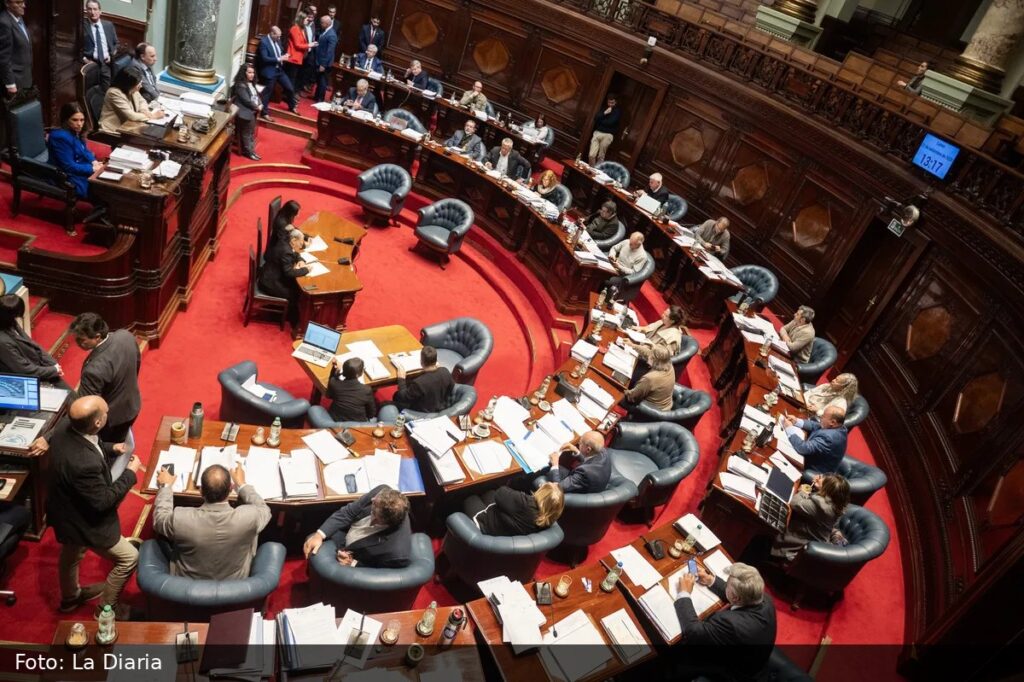
Uruguay’s Chamber of Senators gave final approval to the Accountability Bill after a session that, according to La Diaria, lasted 13 hours. Approval in general was secured with 17 votes out of 30, all from the Broad Front, and the governing coalition kept unchanged the text that had already received half approval in the Chamber of Deputies.
In this way, the initiative will become law without the need for a new round of parliamentary negotiation. According to La Diaria, the measure will come into force on January 1, 2027.
During the article-by-article debate on the 312 articles, one of the points that sparked discussion was the creation of the National Agency for the Management of State Real Estate. The agency will be responsible, among other functions, for administering projects involving state-owned real estate and may also take part in projects linked to their development and maintenance with public funds, loans or donations.
Government senator Bettiana Díaz said, according to La Diaria, that the new agency aims to improve the management of state resources and speed up the use of unused properties. From the opposition, National Party senator Sebastián da Silva questioned the design of the agency and warned about the concentration of responsibilities in structures linked to the Presidency, although he acknowledged the problem of abandoned state assets.
There were also objections within the Broad Front itself. Senator Óscar Andrade praised the initiative, but argued that the law does not fully define the place of properties of social interest or the priority of their social function, always according to La Diaria.
In the public security chapter, Colorado Party senator Andrés Ojeda objected to the evolution of police staffing and pointed out that, according to the Accountability Bill itself, the Ministry of the Interior ended its first year with 75 fewer police officers than at the start. At the same time, he supported a significant part of that section of the bill: he said the opposition backed 41 of the 54 articles related to the area, including the creation of 300 positions for the prison system, funding for patrol vehicles, equipment and biometric identification.
Regarding the National Rehabilitation Institute, whose transformation into a decentralized service is foreseen by the bill under the new name National Reintegration Institute, Ojeda said there is political consensus on the idea, but questioned aspects of the institutional design.
On social policy, government senator Daniel Borbonet highlighted that one of the central changes is the creation of a single allowance for childhood and adolescence, designed to unify cash transfers aimed at households with girls, boys and adolescents. As he explained in the chamber, the regulations provide for payment through the Social Security Bank by card, with the aim of preserving the VAT refund.
Borbonet also stressed that reducing child poverty depends not only on cash transfers, but also on coordinated policies in health, education and housing. In the same debate, Andrade said cash collection should be reserved for exceptional situations, while the main channel would remain the card, according to La Diaria.
Sources
About this note. Written by El Notero with assistance from artificial intelligence, based on what was published by the cited outlet. El Notero did not conduct its own reporting on this event.