Argentina
Eleven years after Tomás Méndez’s breakthrough, Córdoba still has not consolidated outsider figures
In 2015, the journalist finished second in the election for mayor of the Córdoba capital with 23% of the vote. According to analysts cited by Perfil, the provincial political structure and the difficulty of sustaining independent projects explain why a similar case has not emerged again.
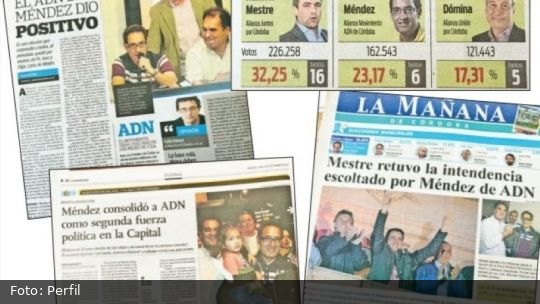
In Córdoba’s municipal election in September 2015, Tomás Méndez produced one of the city’s most memorable political surprises by finishing second in the race for mayor with 23% of the vote. According to Perfil, it was the highest mark achieved by a candidate outside the traditional forces in the provincial capital and has not been repeated since.
In that election, Ramón Mestre prevailed with 32%. According to that outlet, Méndez’s ADN space won in 70 schools, carried Villa El Libertador and outperformed Tito Dómina and Luis Juez by a wide margin.
Over the years, Méndez moved away from politics and settled in Buenos Aires, amid multiple allegations against him, always according to Perfil. Against that backdrop, the article asks why Córdoba has not again produced a figure outside the political system with the ability to gather the vote of disenchanted sectors.
Norman Berra, of Delfos Consultora, told Perfil that Córdoba’s politics are more institutionalized than the national average and that, over the past two decades, none of the outsiders who ran managed to establish themselves in the provincial arena. In that context, he pointed to the continuity of leaders with long careers in both the governing coalition and the opposition.
For Carlos Sicchar, also cited by Perfil, social and cultural factors play a role in the way power is built in Córdoba. Berra added that, although a poll shows 35% of Cordobans do not identify with any party, that void does not translate directly into voting intention: the level of undecided voters is around 10%, which highlights the difficulty of channeling that discontent outside the more formal political structures.
Sicchar also said that influencers could begin to compete for part of that space. As an example, he mentioned Stéfano López’s candidacy for national deputy in the last election, without his TikTok following turning into votes. Even so, he estimated that in future elections there could be lists in Córdoba with social media figures and even interest from traditional parties in incorporating them.
On the national level, Berra told Perfil that the representation crises of recent decades opened opportunities for emerging figures and placed Javier Milei in that context. He also mentioned Dante Gebel, Daniel Hadad and Jorge Brito as part of those attempts. Sicchar, for his part, downplayed the weight of those figures in Córdoba and said they currently have no significant electoral impact in the province.
Sources
About this note. Written by El Notero with assistance from artificial intelligence, based on what was published by the cited outlet. El Notero did not conduct its own reporting on this event.